Evaluate the extent to which industrialization improved the lives of working people in the period circa 1750 to 1900.
Excerpts from historical sources. Cuts are marked with ellipses, and words in brackets were added for clarity.
Document 1
William Radcliffe, English cotton manufacturer who began as a handloom weaver, recollection of changes in spinning and weaving in his home township after 1770, from his book The Origin of the New System of Manufacture, 1828.
From the year 1770 to 1788 a complete change had gradually been effected in the spinning of yarns. That of wool had disappeared altogether, and that of linen was also nearly gone; cotton, cotton, cotton, was become the almost universal material for employment. The hand-wheels . . . were all thrown into lumber-rooms, the yarn was all spun on common jennies . . . .
. . . But the mule-twist now coming into vogue, for the warp, as well as weft, added to the water-twist and common jenny yarns, with an increasing demand for every fabric the loom could produce, put all hands in request of every age and description. . . . new weavers' cottages with loomshops rose up in every direction; all immediately filled, and when in full work the weekly circulation of money, as the price of labour only, rose to five times the amount ever before experienced in this subdivision, every family bringing home weekly 40, 60, 80, 100, or even 120 shillings per week!!!
Document 2
Samuel Coulson, father of girls employed in a textile mill, testimony before the Sadler Committee of the British Parliament investigating child labor in factories, London, 1832.
Question: At what time in the morning, in the brisk time, did those girls go to the mills?
Answer: In the brisk time, for about six weeks, they have gone at 3 o'clock in the morning, and ended at 10, or nearly half past at night. . . .
Question: Were the children excessively fatigued by this labour?
Answer: Many times; we have cried often when we have given them the little victualling we had to give them; we had to shake them, and they have fallen to sleep with the victuals in their mouths many a time. . . .
Question: What was the wages in the short hours?
Answer: Three shillings a week each.
Question: When they wrought those very long hours what did they get?
Answer: Three shillings and sevenpence halfpenny. . . .
Question: At the time they worked those long hours, would it have been in their power to work a shorter number of hours, taking the 3s.?
Answer: They must either go on at the long hours, or else be turned off.
Document 3
Woman mill worker signing herself "Almira," "The Spirit of Discontent," a sketch published in The Lowell Offering, a magazine written by women working in the textile mills of Lowell, Massachusetts, 1841.
"And so, Ellen," said I, "you think it unpleasant to rise so early in the morning, and be confined in the noisy mill so many hours during the day. . . . But we must not forget that there are advantages, as well as disadvantages, in this employment . . . ." . . .
"I believe there is no place where there are so many advantages within the reach of the laboring class of people, as exist here; where there is so much equality, so few aristocratic distinctions, and such good fellowship . . . ."
"As to the morality of the place," returned Ellen, "I have no fault to find. . . . Up before day, at the clang of the bell—and out of the mill by the clang of the bell—into the mill, and at work, in obedience to that ding-dong of a bell—just as though we were so many living machines. I will give my notice to-morrow: go, I will—I won't stay here and be a white slave." . . .
We agreed, that since we must work for a living, the mill, all things considered, is the most pleasant, and best calculated to promote our welfare . . . .
Document 4
Data
Edwin Chadwick, secretary to the Poor Law Commission, Report on the Sanitary Condition of the Labouring Population of Great Britain, presented to Parliament, 1842. Average age at death, in years, from local death registers of the late 1830s and 1840. The report noted that wages in Manchester were nearly double those in Rutland.
Place | Gentry and professional persons | Tradesmen, farmers and their families | Laborers, mechanics and servants
Manchester (manufacturing town) | 38 | 20 | 17
Leeds (manufacturing town) | 44 | 27 | 19
Bolton district (manufacturing) | 34 | 23 | 18
Liverpool (commercial port) | 35 | 22 | 15
Rutland (rural county) | 52 | 41 | 38
Wiltshire (rural districts) | 50 | 48 | 33
Document 5
Friedrich Engels, German socialist writer who worked for his family's cotton business in Manchester, The Condition of the Working Class in England, 1845.
When one individual inflicts bodily injury upon another, such injury that death results, we call the deed manslaughter; when the assailant knew in advance that the injury would be fatal, we call his deed murder. But when society places hundreds of proletarians in such a position that they inevitably meet a too early and an unnatural death, one which is quite as much a death by violence as that by the sword or bullet . . . its deed is murder just as surely as the deed of the single individual . . . . I have now to prove that society in England daily and hourly commits what the working-men's organs, with perfect correctness, characterise as social murder, that it has placed the workers under conditions in which they can neither retain health nor live long; that it undermines the vital force of these workers gradually, little by little, and so hurries them to the grave before their time.
Document 6
Visual source
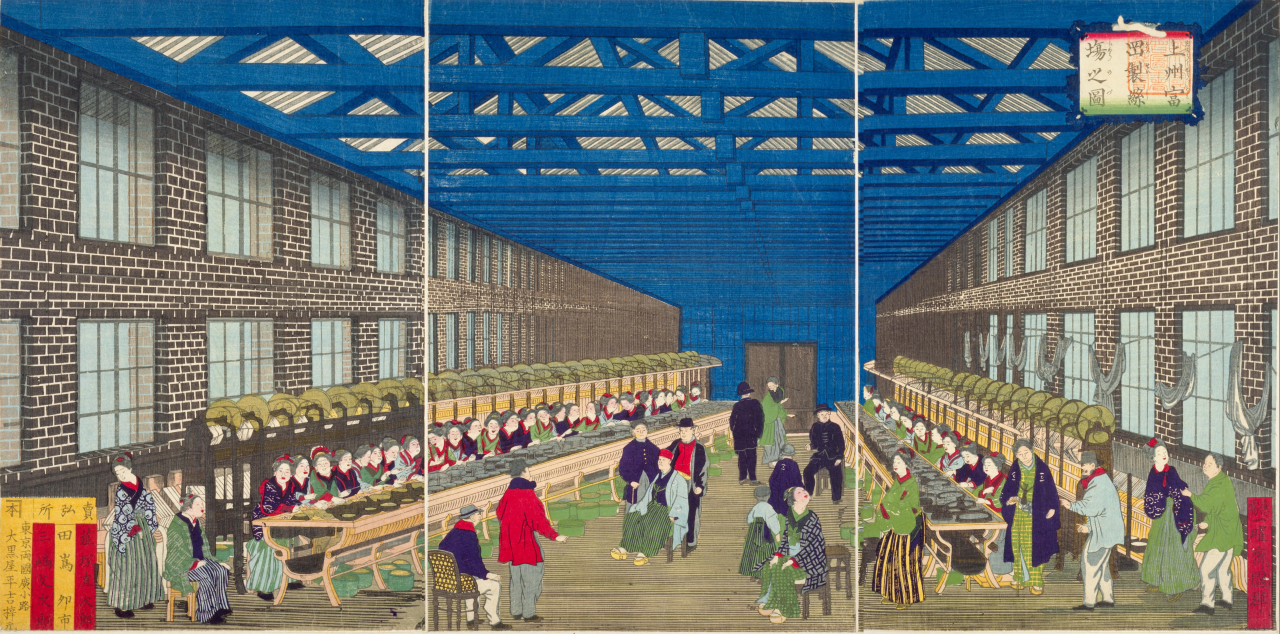
Ichiyōsai Kuniteru, Japanese artist, color woodblock print of the interior of the government-built Tomioka Silk Mill, Japan, 1872.
National Diet Library, Japan, via Wikimedia Commons, public domainDescribe the image
A three-panel color print shows the long interior of a brick factory hall with rows of tall glass windows along both walls and a blue-painted roof of timber trusses. Long rows of young women in kimono sit side by side at reeling benches that run the length of the hall, bent over their work, with round reels mounted along the benches behind them. In the central aisle, men in Western suits, hats and coats stand and walk among the workers, along with men and women in Japanese dress, some of whom stand watching the workers. The title is written in a cartouche at the upper right.
Document 7
Robert Giffen, British government statistician, presidential address to the Statistical Society, "The Progress of the Working Classes in the Last Half Century," London, 1883.
The workman gets from 50 to 100 per cent. more money, for 20 per cent. less work; in round figures, he has gained from 70 to 120 per cent. in fifty years in money return. . . .
It has been shown directly, I believe, that, while the individual incomes of the working classes have largely increased, the prices of the main articles of their consumption have rather declined; and the inference as to their being much better off which would be drawn from these facts is fully supported by statistics showing a decline in the rate of mortality, an increase of the consumption of articles in general use, an improvement in general education, a diminution of crime and pauperism, a vast increase of the number of depositors in savings banks, and other evidences of general well-being. . . . The war of the land nationalizer and socialist is then not so much with the capitalist as with the workman . . . .
How it's scored
1 ptThesis or claim. A historically defensible thesis that establishes a line of reasoning, in one or more consecutive sentences in the intro or conclusion.
1 ptContextualization. Describe a broader historical context relevant to the prompt: events, developments, or processes before, during, or after the prompt's time frame.
2 ptsEvidence from the documents. One point for accurately describing the content of three documents. Two points for using the content of at least four documents to support the argument.
1 ptEvidence beyond the documents. Use one specific, relevant piece of historical evidence that appears in none of the documents, and explain how it supports the argument.
1 ptAnalysis and reasoning: sourcing. For at least two documents, explain how or why the point of view, purpose, historical situation, or intended audience is relevant to the argument.
1 ptAnalysis and reasoning: complexity. Demonstrate a complex understanding: explain nuance, consider multiple variables, analyze both similarity and difference, or qualify the argument with evidence that cuts against it.