Evaluate the extent to which land-based empires depended on religion to legitimize their rule in the period circa 1450 to 1750.
Excerpts from historical sources. Cuts are marked with ellipses, and words in brackets were added for clarity.
Document 1
Anonymous Italian merchant who traded in Safavid Persia, account of his travels describing Shah Ismail I, founder of the Safavid Empire, 1510s.
This Sophy [Shah Ismail] is loved and reverenced by his people as a god, and especially by his soldiers, many of whom enter into battle without armour, expecting their master Ismael to watch over them in the fight. . . . The name of God is forgotten throughout Persia and only that of Ismael remembered . . . [E]veryone, and particularly his soldiers, consider him immortal, but I have heard that Ismael is not pleased with being called a god or a prophet. They are accustomed to wear a red caftan and above that a high conical turban made with a dozen folds, representing the twelve sacraments of their sect, or the twelve descendants of Ali.
Document 2
Leo Africanus (al-Hasan al-Wazzan), Muslim diplomat from Fez, Morocco, who visited Timbuktu in the 1510s, description of Africa written in Italy, 1526.
[T]he king of Tombuto [Timbuktu] that now reigneth, called Abuacre Izchia [Askia Muhammad] . . . after the decease of the former king . . . slew all his sons, and so usurped the kingdom. And having by wars for the space of fifteen years conquered many large dominions, he then concluded a league with all nations, and went on pilgrimage to Mecca, in which journey he so consumed his treasure, that he was constrained to borrow great sums of money of other princes. . . . Here [in Timbuktu] are great store of doctors, judges, priests, and other learned men, that are bountifully maintained at the king's cost and charges. And hither are brought divers manuscripts or written books out of Barbary, which are sold for more money than any other merchandise.
Document 3
Abu'l Fazl, chief minister and official historian of the Mughal emperor Akbar, the Ain-i-Akbari, an official account of Akbar's government, 1590s.
Royalty is a light emanating from God, and a ray from the sun, the illuminator of the universe, the argument of the book of perfection, the receptacle of all virtues. . . . It is communicated by God to kings without the intermediate assistance of any one, and men, in the presence of it, bend the forehead of praise towards the ground of submission. Again, many excellent qualities flow from the possession of this light. 1. A paternal love towards the subjects. Thousands find rest in the love of the king; and sectarian differences do not raise the dust of strife. In his wisdom, the king will understand the spirit of the age, and shape his plans accordingly. . . . 3. A daily increasing trust in God. When he performs an action, he considers God as the real doer of it, (and himself as the medium,) so that a conflict of motives can produce no disturbance.
Document 4
Paul Rycaut, secretary to the English ambassador at the Ottoman court, The Present State of the Ottoman Empire, published in London, 1668.
The absolute power in the Prince implies an exact obedience in the Subjects; and to instill and confirm that Principle no art or industry is wanting, in the education of those who are placed in the Seraglio [palace] . . . To die by the hand or command of the Grand Signior [sultan], when the blow is submitted to, with entire resignation, is taught to be the highest point of Martyrdom; and whose good fortune it is so to suffer is immediately transported to Paradise. . . . [D]oubtless the Tyranny in the Ottoman Emperors, had provoked the people long since to have proved the benefit of another Race, but that there is a strange kind of Devotion and Religion in their minds as to the Ottoman blood, which having been the original of their Empire and greatness, will ever be maintained in high reverence and honour. . . . And may all Christians learn this Lesson from the Turks, and add this principle to the Fundamentals of their Religion, as well as to their Laws.
Document 5
Letter attributed to Shivaji, founder of the Hindu Maratha kingdom in western India, to the Mughal emperor Aurangzeb, protesting the reimposition of the jizya (a tax on non-Muslims), 1679.
That architect of the fabric of empire, [Jalaluddin] Akbar Padishah, reigned with full power for 52 [lunar] years. He adopted the admirable policy of universal harmony (sulh-i-kul) in relation to all the various sects, such as Christians, Jews, Muslims, . . . Brahmans and Jain priests. The aim of his liberal heart was to cherish and protect all the people. . . . But in your Majesty's reign, many of the forts and provinces have gone out of your possession . . . If you believe in the true Divine Book and Word of God (i.e., the Quran), you will find there [that God is styled] Rabb-ul-alamin, the Lord of all men, and not Rabb-ul-musalmin, the Lord of the Muhammadans only. . . . In strict justice the jaziya is not at all lawful. . . . [T]his imposition of the jaziya is an innovation in India and inexpedient.
Document 6
Spiritual Regulation issued by Tsar Peter I (the Great), which replaced the patriarch of the Russian Orthodox Church with a governing council of clergy, with the oath required of the council's members, Russia, 1721.
I acknowledge upon Oath, that the Monarch of all Russia himself, our most Gracious Sovereign is the Supreme Judge of this Spiritual College. . . . [A] Nation has no Suspicion or Apprehension of Tumults and Sedition, from a Synodical Administration, which yet it has too just Cause to fear from a single Spiritual Ruler. For the ignorant Vulgar People do not consider how far the Spiritual Power is removed from, and inferior to the Regal, but in Admiration of the Splendor and Dignity of an High-Priest, consider such a Ruler as a second Sovereign; equal in Power to the King himself, or above him . . . and on the Report of a Quarrel between them, they blindly and distractedly adhere to, and take part with the Spiritual rather than their Civil Ruler.
Document 7
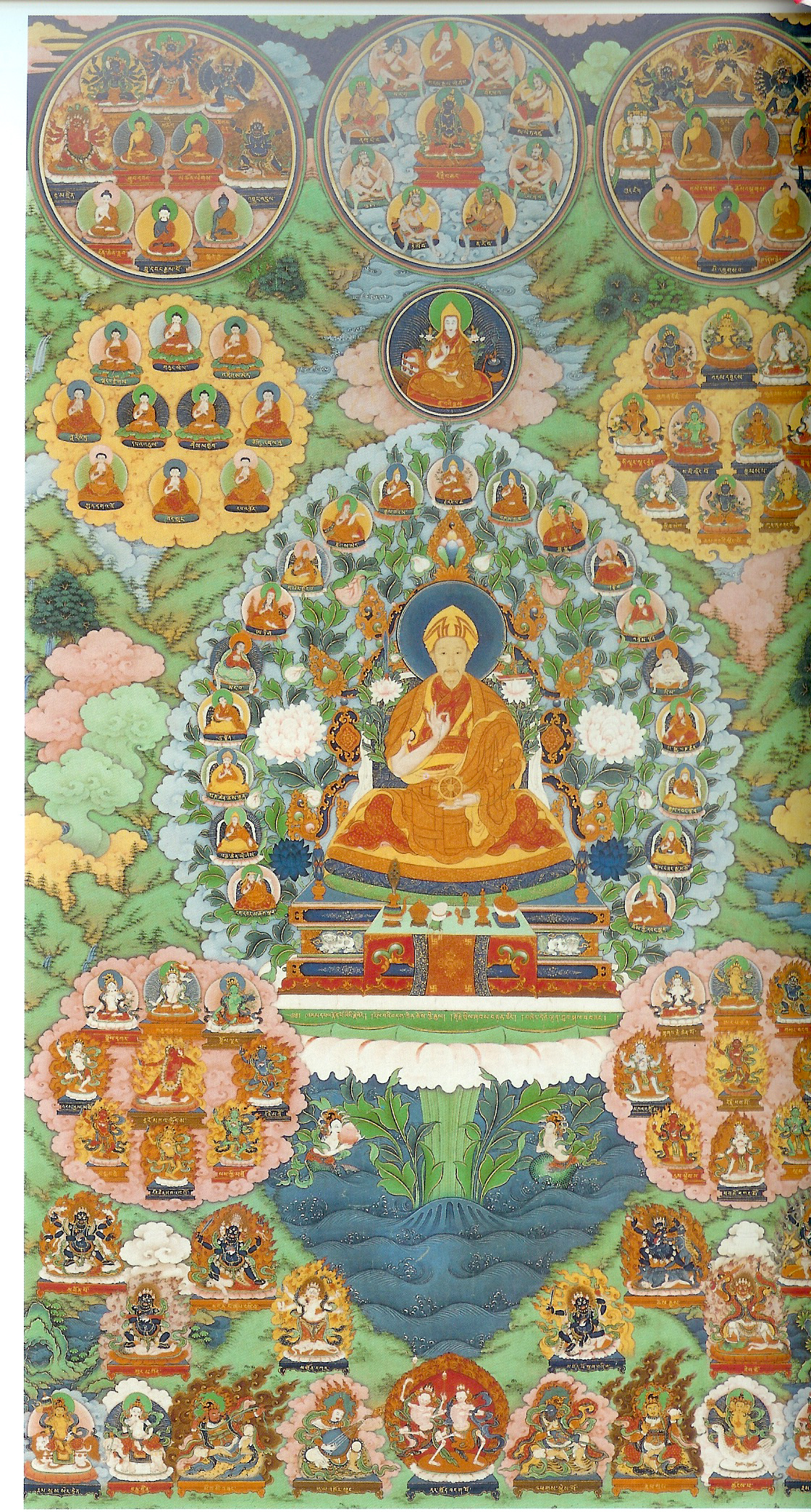
Visual source
Tibetan Buddhist painting (thangka) produced at the Qing imperial court, showing the Qianlong emperor as Manjushri, the bodhisattva of wisdom, Beijing, c. 1750.
Freer Gallery of Art, Smithsonian Institution, Wikimedia Commons, public domainDescribe the image
A large devotional painting in the Tibetan Buddhist style. At the center, the Qianlong emperor sits cross-legged on an ornate throne, wearing the robes of a Buddhist monk and the pointed yellow hat of a Tibetan Buddhist teacher. His right hand is raised in a teaching gesture, and his left hand holds a golden wheel, a Buddhist symbol of the teaching and of the ideal universal ruler. His face is painted in a more lifelike portrait style than the rest of the image. Around him, a great tree holds dozens of small figures of Buddhist teachers and lamas, and the lower part of the painting is filled with Buddhist deities, some peaceful and some fierce. Offerings are set before the throne, and an inscription in Tibetan script runs along its base.
How it's scored
1 ptThesis or claim. A historically defensible thesis that establishes a line of reasoning, in one or more consecutive sentences in the intro or conclusion.
1 ptContextualization. Describe a broader historical context relevant to the prompt: events, developments, or processes before, during, or after the prompt's time frame.
2 ptsEvidence from the documents. One point for accurately describing the content of three documents. Two points for using the content of at least four documents to support the argument.
1 ptEvidence beyond the documents. Use one specific, relevant piece of historical evidence that appears in none of the documents, and explain how it supports the argument.
1 ptAnalysis and reasoning: sourcing. For at least two documents, explain how or why the point of view, purpose, historical situation, or intended audience is relevant to the argument.
1 ptAnalysis and reasoning: complexity. Demonstrate a complex understanding: explain nuance, consider multiple variables, analyze both similarity and difference, or qualify the argument with evidence that cuts against it.